Month: July 2018

  • Nasuni – Global Object File Storage on Steroids – #SFD16

    Nasuni – Global Object File Storage on Steroids – #SFD16

    This was one of my favourite presentations. These guys are not messing around, their product is important to them and their message was clear that they mean business. Not only did the panel provide good feedback during the session, but conversations continued afterwards, and this showed that they really cared about the community’s thoughts and ideas.
    So, who are Nasuni and what do they do? Well, that is a very good question. Nasuni has built their product from the ground up, they provide a cloud and on-premises Global Object File Storage system running on their patented UniFS file system. Nasuni’s main focus is on the ever-growing size of files from Photoshop to Autocad, Audio to UltraHD films and more while storing them in a central location in the cloud to provide quick and efficient access, as well as file redundancy. The architectural layout behind this global object storage is a hub and spoke approach where there is a central location that maintains the “Cold” storage and then each spoke is the branch\remote office accessing the files. Each office can have either a virtual or physical Nasuni appliance for caching to allow “hot” files to be accessed much quicker, while integrating with AD or LDAP for security.
    Nasuni believe that storage requirements are increasing dramatically for individual files and that there should be no limits on whether or not those files can be stored, regardless of their size. UniFS has no limits on; maximum file size, number of files per volume, total volume size or the number of snapshots on a volume. All these open limits aid in the success of Nasuni, along with their file collaboration technology.
    The on-premises cache appliance allows users to pre-seed the files from the global object storage so that they are available when the user will require access. For example, if there is a 4GB file that is required Monday morning, the user can start the pre-seed on Sunday. EA Games proved that Nasuni can make a significant difference in how their organization works with files by going from only testing approximately 3 game builds per day to more than 100. The appliance also holds onto the changes and the files requiring upload when the link to the global system is down.
    Each file is deduped and compressed, while encrypted with a client-controlled key to ensure data is transferred optimally and securely.  When the file is in use, it is locked and advises the next user of the locked file, once released, the file will remain locked for a short additional amount of time to ensure that it has replicated back to the global repository and confirmed before being available for the next person.
    If you’re organisation has multiple offices and you’re looking at centralising your files, whether small or large, I highly recommend checking out more on what Nasuni has to offer.
    See below for the presentations from Storage Field Day 16, both the overview and technical deep dive.

    Overview: 
    [vimeo 277731640 w=640 h=360]

    Technical Deep Dive
    [vimeo 277732048 w=640 h=360]

  • An Introduction to SNIA – SFD16

    An Introduction to SNIA – SFD16

    The first session to kick off SFD16 was presented by SNIA (Storage Networking Industry Association.) “The SNIA is a non-profit global organization dedicated to developing standards and education programs to advance storage and information technology.” – www.snia.org
    This session was an introduction to SNIA and the role that they play in creating technical standards and educational materials. SNIA as a whole works towards bringing vendors into a neutral zone of standards, simplifying technology and creating boundaries to work within. SNIA runs forums, approximately 50 in the last 3 years where webinars and presentations are run to allow anyone to choose to learn about any particular storage technology. They also provides a plethora of educational items from white papers, articles, blogs, IT Training, conferences and certification courses all free, run by SMEs of their own companies.

    SNIA focus’ on many areas from physical storage, persistent memory, data security, network storage, backup, and much, much more. In the words of Dr J Metz, “Generally speaking, if you can think of it, SNIA has a project that’s working on it, or looking to promote it or educate about it.”
    Having learnt more about SNIA and the great work they are doing to help promote and educate about storage, I have gone and looked into a number of their education items, particularly the white papers. I encourage you to also head over and check out their material.
    For more details, head to www.snia.org and check out the video from Storage Field Day 16.
    [vimeo 277519410 w=640 h=360]

  • Zerto – Not Just Short Term DR Retention Anymore

    Zerto – Not Just Short Term DR Retention Anymore

    Last week I had the opportunity to participate in a session with Zerto at their global headquarters in Boston, MA. as part of Storage Field Day 16. This was a session I was really looking forward to after having been a partner for ~3 years and someone who really likes the technology.
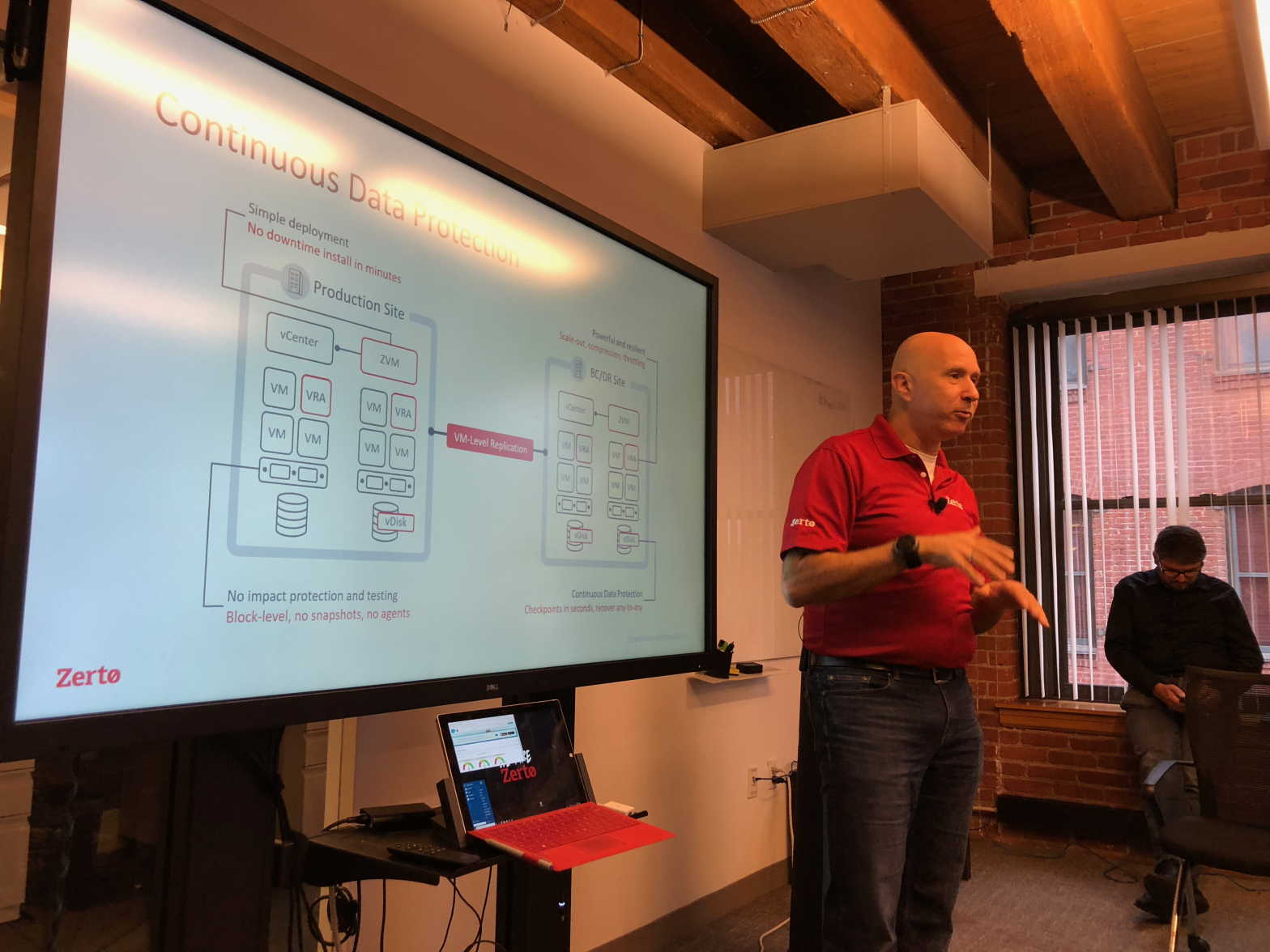
    The session started with the companies Chief Marketing Officer, Gil Levonai going over the core details of how the company has grown and how their block based Continuous Data Protection technology has evolved over the years.
    Zerto Virtual Replication (ZVR) disaster recovery product that uses block based replication allowing it to be hardware agnostic. This means you can use any underlying storage vendor between sites. Zerto is building out their cloud portfolio to allow replication across multiple hypervisors and public cloud companies from vSphere and Hyper-V, through to AWS and Azure, and beyond. There are two main components that are required at both sites for the replication to work, the Zerto Virtual Manager (ZVM) and the Zerto Virtual Replication Appliance (ZVRA). The ZVM is a Windows VM that connects to vCenter/Hyper-V Manager to run the management WebGUI and present and coordinate the VMs and Virtual Protection Groups (VPGs) between sites. The ZVRAs are loaded on to each hypervisor as an appliance and is used to replicate the blocks across sites while compressing the data. One storage platform they do no support currently is VVOLs, however, they are a company that will develop for the technology as there is demand.
    You can set your target RPO to a mere 10 seconds and retain your recoverable data in the short-term journal from 1 hour up to 30 days – meaning you can restore data from a specific time rather than when the backup was last run..
    The VPGs are groups of VMs you want to be part of a failover group. This is where you can create a group for say a 3 tier app where you need each VM to restart in a certain order at certain intervals.

    You can see the Gil’s talk here: https://vimeo.com/277582934
    So, what was the technical discussion during this session? Mike Khusid (Product Management Leader) took us through their new Long Term Retention (LTR) piece that is currently under development to extend the capabilities of ZVR. This is  due to to be included in their next Major release, Zerto 7. This requirement for many enterprises is driven by the need to meet compliance standards and be able to retain data from 7 to 99 years. The benefit of this being included in Zerto’s Continuous Data protection means that you will have an available copy of data that was created ~3 minutes prior to being deleted, ensuring it will be recoverable within the set retention period.
    This is certainly a great way for Zerto to extend their product set to be able to meet the compliance demands that many companies face. As a partner using Zerto, I know this will be a great piece to be able to pass on to our customers.
    You can also catch Mike’s segment here: https://vimeo.com/277583291
    Thank you Zerto for taking the time to present at Storage Field Day #16.